Finniss Scrub
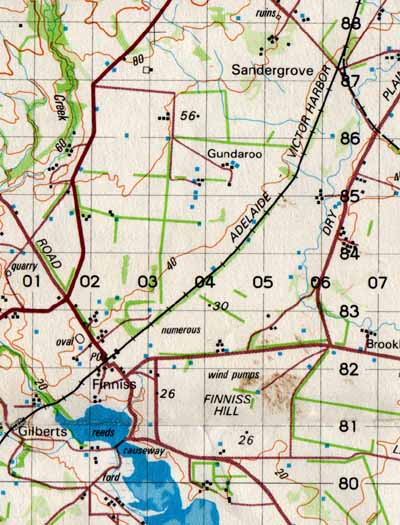
Continuing southwestwards, the line has only slight curves and no intersecting roads. It travels
through the thick Finniss scrub on both sides of the line, populated with unique and rare
flora. Kangaroos and other wildlife can often be seen leaping along in company with the
train.
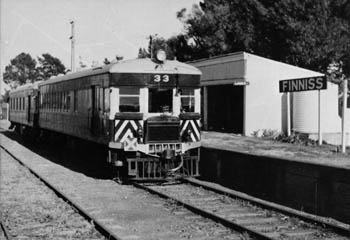
Finniss
Finniss station, named after Col. B.T. Finniss, the assistant surveyor to Colonel Light still
has a platform and passing siding, and the line returns here to “civilisation” just off the main
Strathalbyn to Goolwa road. Half a dozen or so houses form a small settlement at this
crossroads. Finniss was a significant "accounting" station in the early SAR period, with a
Stationmaster until 1927, an electric staff machine from 1912 and train order signals from 1926,
both now removed.
Finniss was one of the original 1867 tramway stations and horse stables were located
on the eastern side of the track. The station still possessed the original shelter shed into the
1970s . One of Finniss’s claims to
fame is that William Bowmans, a local farmer, invented an innovative combine harvester which
marked a milestone in agricultural machinery development.
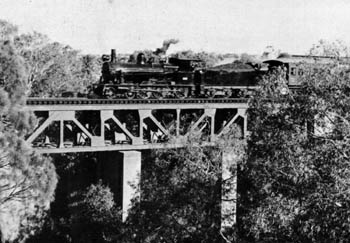
Finniss Bridge
Just south of the station, the line descends in a cutting to cross the Finniss River.
Downstream of the bridge on the northern bank there remains evidence of pits used to quarry
ballast for construction of the Milang line in 1883. Facilities were also located here to
service the contractor's loco which hauled trains up a zigzag track to reach the main line.
The wrought iron bridge across the Finniss River was built for the horse drawn tramway
and subsequently strengthened in 1904 and 1926. It was originally designed with 8 metre brick
arches which were quickly replaced with a 27m steel span. Unfortunately no foundation stone
remains to record the original construction.
Today's construction is interesting in that the two central piers, remnants of the original
bridge, play no part in supporting the span! Come back and look carefully one day - there is a
150cm clearance!
|
![[IMAGE]](logos/haebich.gif)

![[IMAGE]](images/maps/yards/finniss_yard1.jpg)
![[IMAGE]](images/maps/yards/finniss_yard.jpg)